

A dental abscess is a bacterial infection that can be painful or not, and usually containing pus. This type of infection is usually located in the edge of the root of a tooth, or at the gum level around a tooth.
For an abscess to develop, a tooth must either break, or have tooth decay which would have reached the pulp, the central cavity of the tooth. If the infection comes from the gums, the abscess occurs due to periodontitis (gum disease). If not treated, A dental abscess can reach the jawbone and cause severe complications.
Abscess originating from a tooth
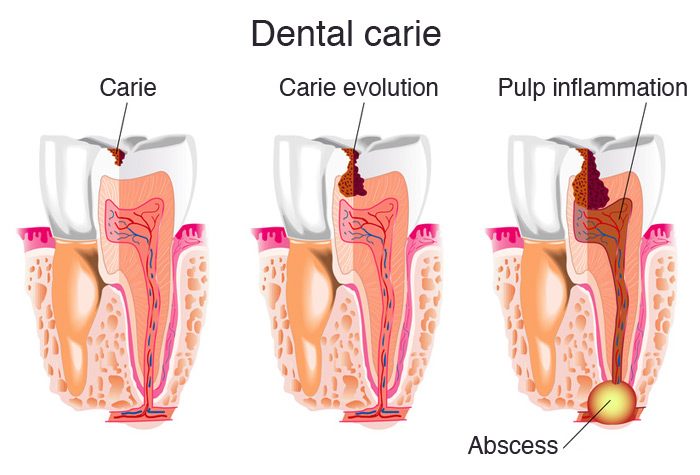
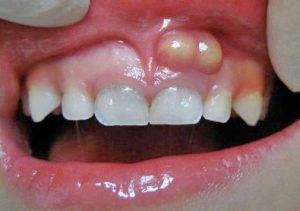 A dental carie (cavity or decay) is a bacterial infection of a tooth. When it is small and limited to enamel or dentin, it can be repaired by a filling or by an inlay or onlay if necessary. But when the decay reaches the pulp (where the nerve is located), the pulp becomes infected and an abscess may develop at the edge of the root (apex).
It’s important to note that a carie and an abscess may develop slowly without causing any pain. But if the infectious expansion is suddenly accelerated, it can cause swelling and a lot of pain. The best way to detect a cavity or an abscess is by undergoing a dental exam by a dentist with dental x-rays.
Abscess originating from gums
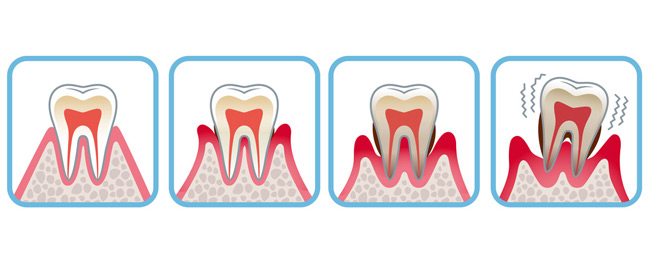
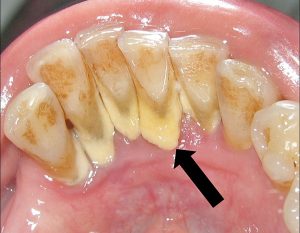 If someone has poor oral hygiene and dental plaque is not remove regularly, this plaque can become tartar which sticks to teeth and gums. Tartar can accumulate and cause inflammation and infection of the gums.
If tartar is not removed by a dental cleaning, it digs slowly through the gums, and destroys the bone that holds teeth. This condition is called periodontitis. It’s a disease that can generate an abscess at the level of the gums with swelling and pain. But periodontitis can also develop very slowly without pain but by destroying bone. The tooth then moves more and more until it falls off by itself or needs to be extracted.
Symptoms
 The main symptom of a dental abscess is an acute and intense pain from the infected tooth. There may be long periods without pain, that can go on for days or months before you notice that you have an abscess. Other symptoms can also be noted:
- Redness and swelling of the gums
- Pain while chewing.
- Headache, fever and general fatigue.
- A significant amount of green and foul-smelling pus that eventually drifts out and the pain stops right after.
Complications
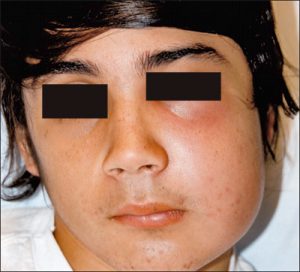 If a dental abscess is not treated, it can lead to serious complications that can affect a person’s health dramatically and that sometimes can even be fatal:
A fistula is an opening that appears on the gum when the abscess is chronic. The pus drains out in the mouth by itself. When there is a fistula, the pain generally decreases, and you may see a small red or white button on the gum.
Tooth loss may occur because the abscess can infect the bone that holds the tooth, and if too much bone damaged (periodontitis), the tooth moves more and more and eventually falls out.
Brain abscess may occur. The infection could spread from teeth to the brain through blood vessels. An infection of the brain can lead to a coma.
Sinus infection can take place since the roots of upper molars are located near the sinuses. If the dental abscess produces pus, sinuses may fill with pus that comes from teeth.
Bacterial endocarditis may occur when bacteria from a dental abscess reaches the heart through blood vessels. These bacteria reaching the heart may infect it, which sometimes lead to fatal consequences.
Ludwig’s angina is a serious infection, and sometimes fatal, which affects parts of the face and the lower jaw. It usually occurs in adults suffering from a tooth abscess that was never treated. The danger is that it can grow enough to block the airways of the person who’s suffering from it, and cause suffocation leading to death.
Treatments
Caring for an abscessed tooth can vary depending on the severity of the infection, and whether it originates from the gum or the tooth:
- taking antibiotics may be necessary beforehand, but this is not a final treatment because antibiotics only reduce the abscess temporarily;
- pus drainage may be indicated if the abscess is very developed;
- if the abscess comes from the gums, drainage and curettage may be needed;
- if the abscess comes from the tooth itself, an endodontic cleaning (root canal), followed by an eventual placement of a crown, allows a proper treatment;
- if someone does not have the financial means to procede with a root canal and a dental crown, they should not keep the abscess in the mouth; the tooth should be extracted instead to avoid serious health consequences; it’s always better to keep our own teeth but partials or dental implants can eventually replace missing teeth;
- if a tooth is destroyed too much or if it does not have enough bone to support it, extracting that tooth may be necessary.
Prevention
 Having a dental abscess can be an unpleasant or a very painful event. But there are several ways to avoid it:
- Daily dental hygiene, including brushing your teeth 3 times a day, and flossing twice a day.
- Seeing your dentist for regular dental exams, preferably twice a year.
- Regular dental scalings and cleanings.
- Reducing the use of tobacco products, or stopping altogether.
References
- Wikipedia (Dental abscess).
- Emergency Dental Care (How to Temporarily Relieve My Abscessed Tooth Pain).
- Kits Family Dental (Gum Boil in Children – AKA Dental Abscesses).
- The Queen of Dental Hygiene (It’s all About the Plaque (No Tartar!) ).
- WebMD (Dental Care for a Beautiful Smile ).
The information above should be used as a reference only. Any medical decision should not be taken before consulting a health care professional.
The masculine gender may have been more used in the article, but without prejudice, to make reading easier.
Category dental problems
- Abfraction
- Abrasion
- Ankylosis
- Anodontia
- Attrition
- Broken fillings
- Bruxism (Teeth Grinding)
- Cavity (tooth decay)
- Cold sore (herpes labialis)
- Dental abscess
- Dental plaque
- Denture Irritations and Infections
- Denture stomatitis (prosthetic stomatitis)
- Dry socket
- Erosion
- Fluorosis (dental)
- Gingival hyperplasia
- Gingival pocket
- Gingivitis
- Gum Disease (Periodontal Disease)
- Gum recession
- Halitosis (Bad Breath)
- Hyperdontia (supernumerary teeth)
- Hypocalcification
- Hypodontia
- Impacted tooth (tooth impaction)
- Leukoplakia
- Lichen planus
- Malocclusion (Misaligned Teeth)
- Microdontia
- Micrognathia (micrognathism)
- Mucocele
- Oligodontia
- Oral cancers
- Oral candidiasis
- Overbite
- Overjet
- Pericoronitis
- Periodontal pocket
- Periodontitis
- Prognathia (prognatism)
- Resorption
- Retrognathia (retrognatism)
- Sleep apnea
- Tartar (Calculus)
- TMD (Pain and Cracking of the Jaw)
- Tooth Discolouration
- Tooth sensitivity (sensitive teeth)
- Torus
- Trismus
- Ulcers and canker sores
- Xerostomia (Dry Mouth)



Thankyou for information on gum hygiene
You are very welcome Juliet! And thank you for reading!
“For an abscess to develop, a tooth must either brake, or have tooth decay which would have reached the pulp, the central cavity of the tooth”
Teeth break, not brake.
Thank you Mr. Jeffery, I just made the correction 🙂
Thank you for the information… I’ve woke with my second abscess in 3weeks and it’s on my bone so I need a root canal
Really sorry about that. I am sure your root canal process will go very well 🙂
Hello, Dr. Youseff!
I am a Health Promotion Facilitator with Reproductive Health, Healthy Children and Families (HCF), Alberta Health Services (located in Alberta, Canada). We are a non-profit provincial public health program. Our team is responsible for the development of the http://www.HealthyParentsHealthyChildren.ca, which is a practical guide to pregnancy and being a parent. Part of this work includes print copies of this guide as well as other health promotion resources for families. We would like to know if we could have permission to reproduce one of the images on your website. Please contact me at amy.n.graham@ahs.ca to discuss. Thank you!
Hello Amy, yes you may, no problem 🙂
I buy my images from a website called fotolia.ca, I am not sure how the permission would work.
Thank you, Dr. Yousef! I will look into their permission requirements. 🙂
Do you happen to know the ID # for the image of the child’s dental abscess photo? I reviewed the fotolia.ca site but can’t find it. Many, many thanks!
I’m very sorry Amy, as I didn’t keep that information 🙁
Hello Dr. Youssef, i have a recurring abces for years, often with green puss (yuck?). Also after my tooth has been removed, it appears at the same spot. I visit a hygienist regularly and care for my teeth daily. What should I do?
Hello Pam,
Looking and finding the origin of the abscess is very important. It might be another tooth, or might be coming from the gums. When you do your cleaning with a hygienist, does a dentist check your teeth? Maybe next time you can mention the recurring abscess and have him or her take a look at it.
It’s about teeth for God’s sake, and you had to apologize for the gender you used? I hope an asteroid hits soon and wipes out the stupidity!
And the drama!
I have had a root canal done and a cap put on my back tooth but every once in awhile I’ll get an abscess on my gums above it some nasty fluid comes out what do you recommend to be done?
Hello Tabitha,
Your abscess might be either coming from that tooth, or from somewhere else very near that tooth (gums, neighbour tooth or other structure). I recommend that you see your dentist to have it checked and not to wait a long time, as an abscess is not good to have in your mouth.
I have an abscess on my palate besides where is my tooth ache the dentist want to pull it out but I don’t want to because I have the abscess beside my tooth and if he pull it out and having the abscess I can died so I want him to open and drain the abscess first and then take some antibiotics for the infection and the he can pull my tooth out ….and then they tell me have bacteria inside my gums what I do ???!!! I’m getting crazy
Hello Bertha, I think your dentist knows the right way to proceed with your tooth treatment. But if you are not sure, you can always seek a second opinion before the treatment. A second opinion is best done in person, with another dentist who can see you, analyze your tooth and your x-rays.