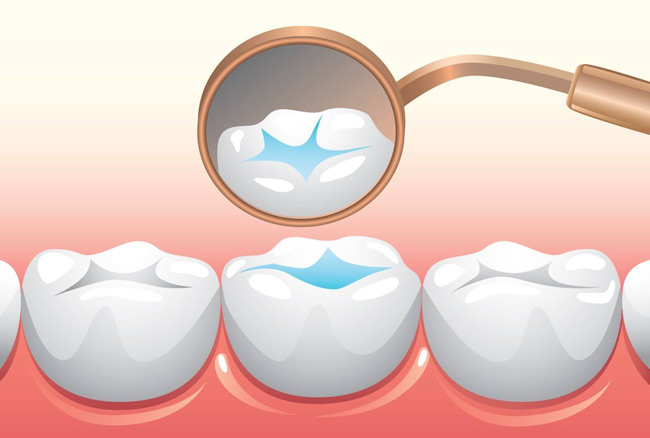
A dental sealant (also called pit and fissure sealant) is a thin layer of tooth coloured resin that protects the occlusal surface (chewing surface) of a tooth. Sealants are generally placed on permanent molars and premolars to prevent these teeth from having cavities.
What is a dental sealant?
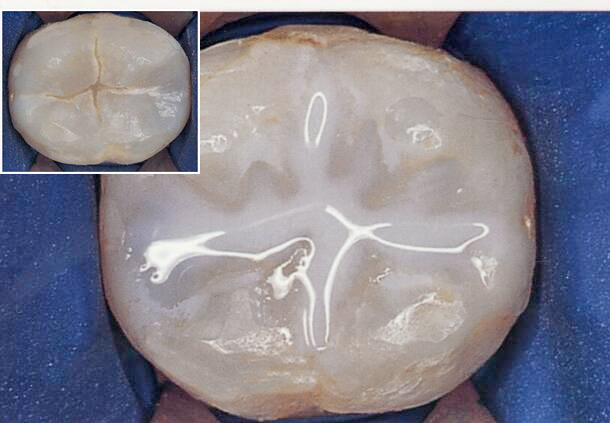
Studies show that the majority of cavities for kids under 15 years of age are developed on the occlusal surface of a tooth (chewing surface). These surfaces contain natural grooves called pits and fissures where food sticks easily in them. Dental plaque can therefore accumulate and can be hard to remove, even with a conscientious brushing, if the bristles of the toothbrush are thicker than the grooves of the teeth. If plaque stays a long time in the grooves, cavities can develop.
Dental sealants are resins placed by the dentist or hygienist in the pits and fissures of teeth. Filling unprotected pits and fissures will create a smooth surface that is easy to clean with a toothbrush.
It’s important to remind kids and parents that dental sealants only protect the chewing surfaces of teeth. They do not seal the surfaces in between teeth. Therefore brushing and especially flossing is important in order not to get cavities on those areas.
Who should get sealants?
A dental sealant is a preventive treatment. It does not heal a tooth, but protects it from cavities.
Patients who should get dental sealants are:
- kids between the ages of six and fourteen, on their molars and premolars as soon as these teeth have erupted;
- young kids with primary teeth (baby teeth or deciduous teeth) that have deep grooves;
- adults can also benefit from sealants even though the risk for cavities is lower.
The best candidates for sealants are therefore kids and teenagers, because they are the ones that are at most risk for cavities.
Steps in placing sealants
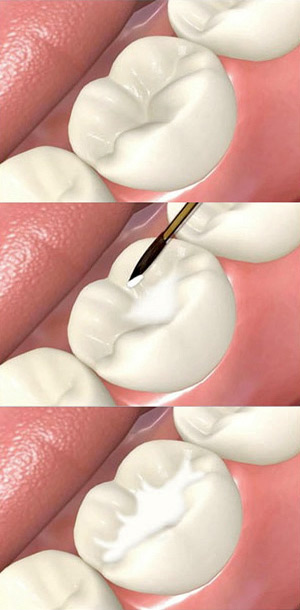 Placing dental sealants is very similar to placing white fillings. But because there is no drilling or minimal drilling, local anaesthesia is not needed and there will not be any pain felt.
Here are the steps in placing a dental sealant:
- the tooth is cleaned thoroughly;
- if the grooves of the tooth have a cavity starting, it is eliminated;
- an acidic solution is placed on the surface of the tooth for a few seconds to make it rough, which helps the bond;
- the tooth is rinsed and dried;
- the liquid sealant is applied to the tooth that forms a direct bond and a blue light hardens it;
- sometimes the dentist can choose to put a composite restorative material (white filling) as a sealant allowing more resistance.
Lifespan of a sealant
A sealant can last between three and ten years, depending mainly of oral hygiene and the material used (sealant versus composite). It is important to get the sealants checked for fractures or wear during routine exams. The dentist can therefore replace the sealants when needed.
References
- Mouth Healthy (American Dental Association) (Sealants).
- Wikipédia (Scellement de sillons).
- CDC (Centers for Disease Control and Prevention) (School-Based Dental Sealant Programs).
The information above should be used as a reference only. Any medical decision should not be taken before consulting a health care professional.
The masculine gender may have been more used in the article, but without prejudice, to make reading easier.
Category Treatments
- Apicoectomy
- Bite splint
- Braces
- Cantilever bridge
- Clasp
- Curettage
- Dental anesthesia
- Dental bridge
- Dental cleaning
- Dental crown
- Dental exam
- Dental extraction
- Dental fillings
- Dental implant
- Dental post
- Dental sealant
- Dental veneer
- Dental x-rays
- Dentures and partials
- Direct pulp capping
- Endodontic retreatment
- Facial mask
- Frenectomy
- Gingivectomy
- Gingivoplasty
- Graft
- Headgear
- Immediate denture
- Indirect pulp capping
- Indirect restoration
- Inlay
- Inlays and onlays
- Internal bleaching
- Laser cavity detection
- Lip bumper
- Maryland bridge
- Mini-implants or mini-screws for orthodontics
- Mock-up
- Mouthguard
- Onlay
- Oral surgery
- Orthodontics
- Orthognathic surgery
- Palliative treatment
- Periodontal (gum) disease treatments
- Pontic
- Pulpectomy
- Pulpotomy
- Removable partial denture
- Root canal treatment
- Sinus lift
- Tooth whitening
- Wisdom teeth