
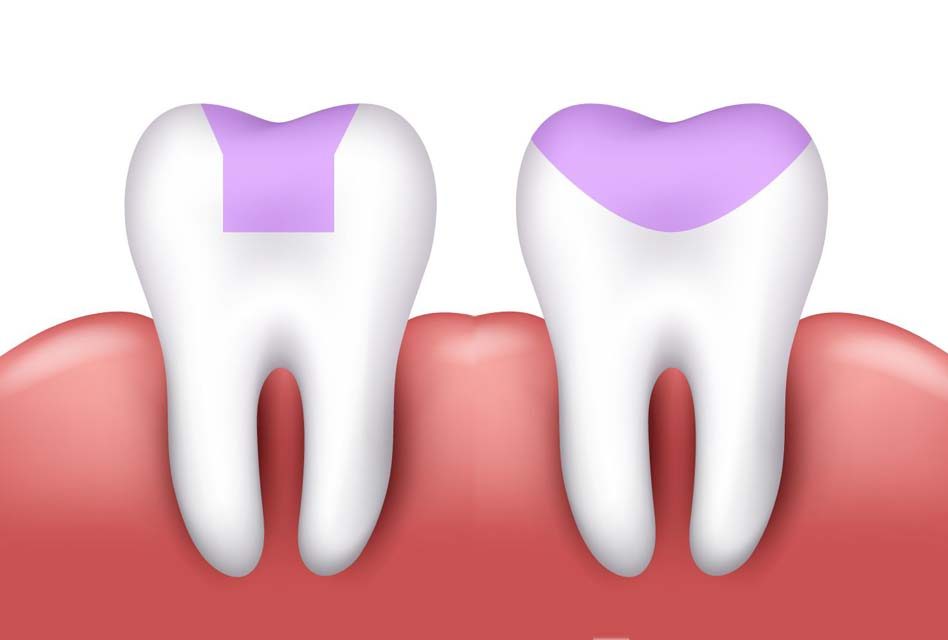
Inlays and onlays are restoration made in a dental laboratory to repair a tooth that has a defective filling or a cavity. Instead of using the usual restorative materials like amalgams (silver fillings) or composites (white fillings), it is possible to turn to a more solid method to fix a tooth.
Inlays can restore teeth with little destruction. Onlays are bigger restorations where there was previously a big cavity or a big filling.
There are different materials to make inlays and onlays, such as gold, porcelain, and resin. Gold being more durable but less esthetic than porcelain, the choice of the material is done according to the patient’s desires, the dentist’s recommendation, and the location of the tooth being repaired.
If the destruction of the tooth is extensive, the dentist might instead suggest using a crown to repair the tooth.
Advantages of inlays and onlays
- Gives resistance to the tooth and allows avoiding fractures.
- Gives more durability that the conventional fillings in amalgam or composite.
- Allows conserving more the integrity of the natural tooth and avoiding the long run root canals.
- Contributes to give back the esthetic aspect of the tooth.
Lifespan of inlays and onlays
Inlays and onlays last between five and twenty years, mainly depending on the oral hygiene and the maintenance, the material used (gold versus porcelain), and also of oral habits (grinding the teeth, chewing on ice, or biting the nails lessen the lifespan of an inlays and onlays).
References
WebMD (www.webmd.com)
Wikipedia (www.wikipedia.org)
Ordre des Dentistes du Québec (www.odq.qc.ca)
The information above should be used as a reference only. Any medical decision should not be taken before consulting a health care professional.
The masculine gender may have been more used in the article, but without prejudice, to make reading easier.
Category Treatments
- Apicoectomy
- Bite splint
- Braces
- Cantilever bridge
- Clasp
- Curettage
- Dental anesthesia
- Dental bridge
- Dental cleaning
- Dental crown
- Dental exam
- Dental extraction
- Dental fillings
- Dental implant
- Dental post
- Dental sealant
- Dental veneer
- Dental x-rays
- Dentures and partials
- Direct pulp capping
- Endodontic retreatment
- Facial mask
- Frenectomy
- Gingivectomy
- Gingivoplasty
- Graft
- Headgear
- Immediate denture
- Indirect pulp capping
- Indirect restoration
- Inlay
- Inlays and onlays
- Internal bleaching
- Laser cavity detection
- Lip bumper
- Maryland bridge
- Mini-implants or mini-screws for orthodontics
- Mock-up
- Mouthguard
- Onlay
- Oral surgery
- Orthodontics
- Orthognathic surgery
- Palliative treatment
- Periodontal (gum) disease treatments
- Pontic
- Pulpectomy
- Pulpotomy
- Removable partial denture
- Root canal treatment
- Sinus lift
- Tooth whitening
- Wisdom teeth


I am in America, I am interested in pricing? I need new bonding on my from 6 teeth, what is the cost?
Jim
Hello Jim,
America is a big continent (or big country if you are referring to the USA), and prices are different from state to state (or country to country). Also bondings have different prices per tooth depending on how many surfaces of a tooth they cover.
Myself I live in Montreal, Canada. Bondings with composite (white filling) on a front tooth cost from around $100 to $300 per tooth.
Bondings are of course different from inlays and onlays, the title of this article.
Thank you for your interest!
I live in USA Ohio do you think you come to USA for your client
You are very kind, thank you 🙂
My name is Rashid Khan form KL Malaysia.
Hello Rashid! And thank you for stopping by!