
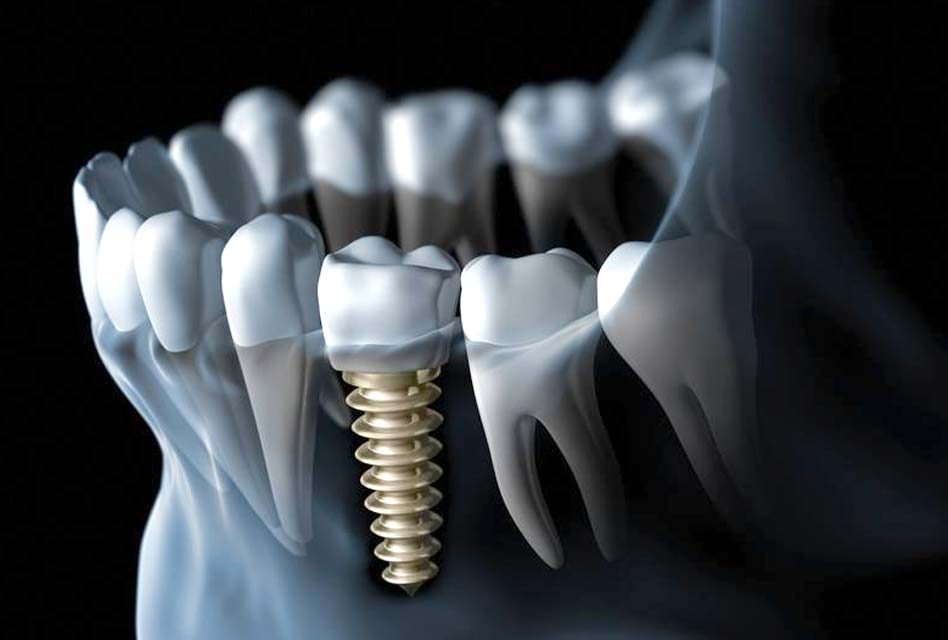
A big portion of the population suffers from missing one or many teeth. This situation does not optimize health because it constraints the proper chewing of food, and these chewing forces weaken the remaining teeth in the mouth. For many years, the treatments for replacing absent teeth were bridges and dentures. Today, there are also implants.
An implant consists of a small cylinder generally made of titanium that is fixed in the bone of the jaw. It is a replacement of the root of a tooth that offers a solid base for prosthetic dentures or a crown, acting like a real tooth that is solid to chew with.
There are two types of implants:
- Removable dental implants that are not fixed to the bone of the jaw.
- Dental implants that are fixed to the bone by osteointegration, which means that the bone is in close connection with the implant, supporting an almost normal chewing.
Advantages of dental implants
- Appearance improvement, since implants resemble real teeth. In addition, since they are fused with the bone, the implants become permanent.
- Improvement of speech, contrary to regular dentures that can move when we speak, implants allow talking without being preoccupied with instability.
- Improvement of comfort, because implants become part of the mouth, giving the feeling of real teeth.
- Eating easier, contrary to regular dentures that can be unstable in the mouth.
- Dental implants do not require reducing the teeth next to them like it is done for bridges.
- Implants last many years. They require the same maintenance as real teeth, such as brushing, flossing, and regular visits at the dentist. With proper care, implants can last a lifetime, with the prosthetic or crown portion being changed every ten to fifteen years.
Success rate of implants
The success rate can vary depending on the area of the mouth where the implants are placed and the state of the bone supporting them. In general, implants succeed 97% of the time. With proper care, this success can last a lifetime. The success rate is lower for smokers. People with diabetes, heart problems, or people who have received radiation therapy to the head and neck have to be evaluated carefully before having implants done.
Steps in the placement of implants
- An individualized treatment plan is established by the dentist or the surgeon according to the needs of the patient, the state of the mouth, and its health.
- The “root” portion of the implant is then placed in the alveolar bone. This part of the implant made of titanium resembles a post of a few millimeters in diameter. This surgical intervention is done under local anesthesia either in a dental clinic or a hospital. When the bone heals, it becomes embedded all around the implant granting it a very solid anchor. Recovery takes few months.
- Once the implant is anchored in the alveolar bone, an abutment is attached to the implant where the crown or the dentures are held on.
- The dentist must take an impression of the abutments, as well as the other teeth of the mouth, if there are any, to make the crown or the dentures.
References
WebMD (www.webmd.com)
Wikipedia (www.wikipedia.org)
Ordre des Dentistes du Québec (www.odq.qc.ca)
The information above should be used as a reference only. Any medical decision should not be taken before consulting a health care professional.
The masculine gender may have been more used in the article, but without prejudice, to make reading easier.
Category Treatments
- Apicoectomy
- Bite splint
- Braces
- Cantilever bridge
- Clasp
- Curettage
- Dental anesthesia
- Dental bridge
- Dental cleaning
- Dental crown
- Dental exam
- Dental extraction
- Dental fillings
- Dental implant
- Dental post
- Dental sealant
- Dental veneer
- Dental x-rays
- Dentures and partials
- Direct pulp capping
- Endodontic retreatment
- Facial mask
- Frenectomy
- Gingivectomy
- Gingivoplasty
- Graft
- Headgear
- Immediate denture
- Indirect pulp capping
- Indirect restoration
- Inlay
- Inlays and onlays
- Internal bleaching
- Laser cavity detection
- Lip bumper
- Maryland bridge
- Mini-implants or mini-screws for orthodontics
- Mock-up
- Mouthguard
- Onlay
- Oral surgery
- Orthodontics
- Orthognathic surgery
- Palliative treatment
- Periodontal (gum) disease treatments
- Pontic
- Pulpectomy
- Pulpotomy
- Removable partial denture
- Root canal treatment
- Sinus lift
- Tooth whitening
- Wisdom teeth


Very educative article. I will like to have a full dental implants. 95% of my teeths needs to be changed completely. How do i consult you. I livenin Cameroon but i visit canada often. I will like to have a consultation.
Hello Vicky, and thank you for your interest 🙂
Myself I practice in the Montreal area. Usually I do not place implants myself, I refer my patients to a maxillo-facial surgeon. There are lots of good ones all over Canada.
Hi sir
Can you meeting me?
I’m from Pakistan .
Hello Mr. Muhammad. Thank you, but I live in Canada.
Amazing, I from Cancun and for me will be great to contact you and travel to Montreal congratulations.
Thank you very much Maria for your nice message!
Have a great day, and enjoy the beautiful weather and beaches of Cancun!
Buenos días hablan español
Buenos dias, muy poco 🙁
Hello Dr Anton Youssef. Lower no more teeth and gums resided. Do I still stand a chance for implant? I am 62 years old.
Hello Miss Helen,
I can be possible yes, but if there is little gums left, bone graft is needed.
good day, do you have an affiliated branch in the philippines?
Hello Cris,
Sorry, I am only located in Canada.
Hey I’m from Australia do you know any one you can recommend me to. As I got 90 percentage of all my teeth out. And I might need some implantings. I like your job and the passion you got for it. I really adore you if you can refer me to anyone. It will be nice. If not I’m gonna save up and come to Montreal and come see you. So I can get my smile back.
Hello Alpha! And thank you very much for your beautiful encouragement.
It happens that I know a fantastic dentist in Cairns. Her clinic’s name is “Northern Beaches Dental Care”!
Hello Alpha,
It is a great idea to find a dentist who is as passionate and experienced as Dr Anto! I am in Queensland though … I would suggest finding a dentist local to you who has several years worth of experience in placing implants. See a couple for a consultation to find someone you are comfortable with. Good luck, implants are a very strong and long lasting option!
Dr Karen.
Northern Beaches Dental Care
Thank you Dr. Karen! But you are as passionate, if not more than me, and it is a privilege to know you!
Bien interessé par des implants… dans l’attente d’une reponse pour savoir quels sont mes possibilites Dr youssef
Je suis au senegal.
Bonjour Mohames,
Effectivement, les implants dentaires sont la meilleure option pour remplacer des dents qu’on a perdu.
Vivant au Canada moi-même, je ne connais malheureusement pas de dentistes au Sénégal à vous référer 🙁
Hello dr Anto Yousself
I lived at Toronto,and I did implants from Feb —2015,after 3hour dr Murray Arlin take off all upper teeth’s for implants surgery.
I having hard time with my health and a lot trouble ,my weight before 105-107pounds,after few months i lost a lot of weight,only 64pound, ambulance send emergency alot of time …but until now my implants cannot wear it,I always put glue for dentures, but now glue can’t stick when upper roots fell out,dr Arlin send me to another his partner with reasons my bones,he took 1implant root out for bone grow
Other implants roots right now shaking,, they ask more money,I’m in the stressfull
I hope you keep some advice and find out who can help me ,what I have to doing now
Thanh’s for be patient with me
ANHTUYET PHAM
Toronto 9.00
Hello Anh Tuyet,
I would like to help you, but I need more information on what your oral situation is.
What would be the cost for a complete lower set of teeth done this way? Would they be able to be done all at once? I can have a denture on the top just not on the bottom because of an overbite. I live in Saskatchewan and have blue cross so I need to know the cost done in the hospital.
Hello Darlene,
Yes it is possible to have regular dentures on top and dentures on implants for the bottom. As for the cost, it is important to have a thorough exam by a dentist before making an estimate, as too many treatment and diagnosis parameters are at concern.
My Name is Yanni from Sydney
Send me an email and address I require dental work on my teeth
Hello Yanni,
Thank you so much, but I live in Canada, very far away from Australia. I do not place dental implants myself, I work with colleagues for implants. I am sure there are many good dentists in Sydney that can do your work.